The Question the 2008 Fleet Still Answers
What single technical system most clearly divided the leading 2008 IMOCA 60s from the chasing pack? The finishing order points first to canting-keel maturity.
This is an archival interpretation, not a universal performance law. The relevant fleet left Plymouth on 11 May 2008 for a westbound Atlantic course of roughly 2,800 nautical miles to Boston. Loïck Peyron completed the passage on 23 May in 12 days, 11 hours, 15 minutes and 35 seconds. The next two monohulls arrived within hours, making even a short period of protective depowering consequential.
The useful first test is not whether a boat carried the newest sail inventory, followed the most fashionable routing model, or had the best-known skipper. It is whether the boat could use its canting keel at the intended angle without reported restriction. Only then does it make sense to compare the tactical variables layered above that mechanical foundation.
The evidence supports a firm but bounded conclusion: canting-keel maturation, rather than novelty alone, was the most persuasive separator in the 2008 fleet.
In this Article
- Canting Keels as the Righting-Moment Engine of the Class
- Structural Failures That Exposed Incomplete Maturity
- Front-Runners Who Made the System Work Offshore
- Why Sail Plans, Routing, and Reputation Ranked Second
- Engineering Maturity Versus Experimental Risk in One Generation
- What the 2008 Generation Handed to Later IMOCA Cycles
- The Closing Judgment
The central comparison covers the period from the 11 May start to the winning passage on 23 May, although later finishers extended the race record beyond that interval.
Canting Keels as the Righting-Moment Engine of the Class
A canting keel rotates around a transverse pivot beneath the hull. Hydraulic pressure moves the fin, shifting the bulb to windward and increasing its horizontal lever arm. That offset produces greater righting moment without relying on extra crew ballast, a decisive consideration aboard a 60-foot single-handed monohull.
A fixed keel delivers power through a ballast position that remains constant relative to the hull. A canting system changes that relationship. When the bulb moves to windward, the skipper can resist more heeling force and convert a larger sail load into forward motion, provided the keel structure and steering appendages remain within their working limits.
One system, not three separate components
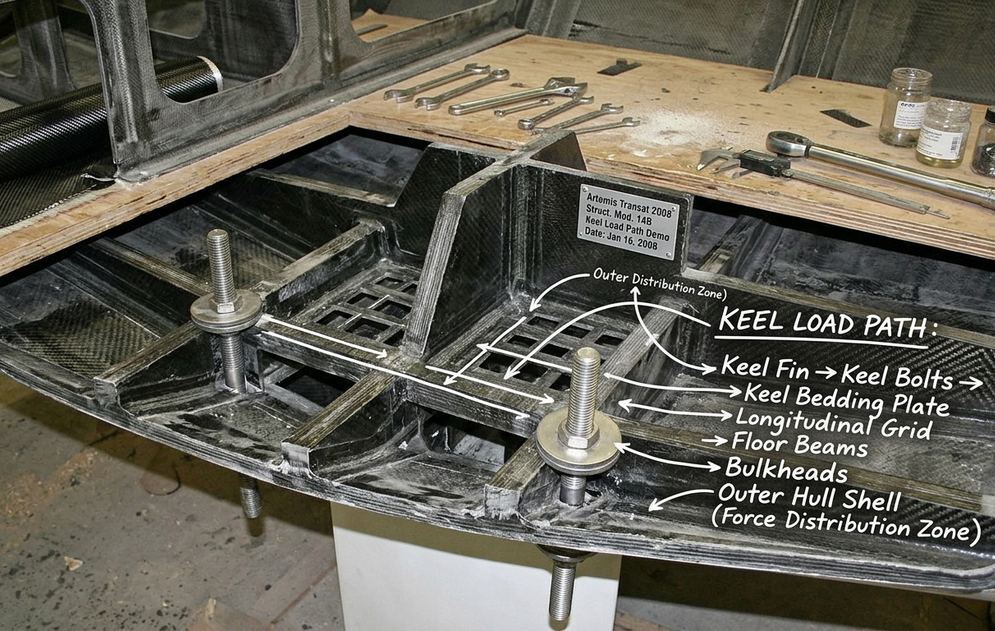
The hydraulic ram, keel fin and bulb cannot be judged independently. Pressure must hold the selected cant angle. The pivot and bearings must control movement. The fin must carry the bulb load, while the keel box transfers repeated forces into the hull.
That sequence matters across a North Atlantic passage lasting roughly 12 to 15 days for the leading group. Tacks, sail changes, wave impacts and cant adjustments impose repeated load reversals rather than one clean proof load. The theoretical gain exists only while every link continues to function.
Field Note: Follow the load path before judging the headline specification. A large cant angle has little competitive value if pressure loss, bearing movement or structural concern prevents the skipper from using it offshore.
Structural Failures That Exposed Incomplete Maturity
A keel need not detach to decide a race. A leaking ram seal, growing pivot clearance or concern around the fin root can force reduced cant and a smaller sail plan while the complete structure remains attached.
Each fault changes decisions aboard in a different way. A ram seal that does not reliably hold pressure undermines confidence in the selected angle. Bearing play permits unwanted movement at the pivot. Deformation, unfamiliar noise or cracking near a heavily loaded connection raises a more serious question: can the boat continue to carry full sail without worsening the problem?
The inspection chain
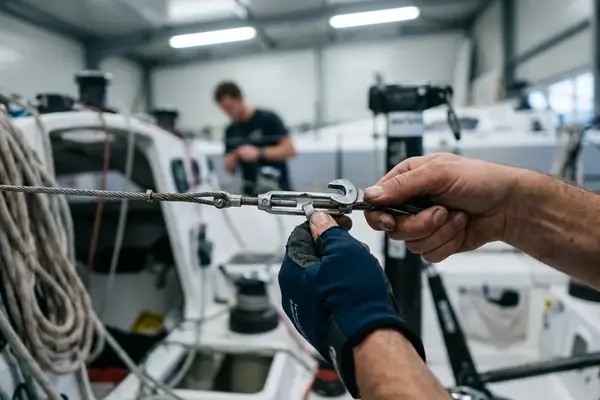
The practical inspection sequence begins with hydraulic fluid and ram attachments, then proceeds through the pivot bearings, keel-box structure, fin root and bulb connection. Leakage, play or visible movement at any point can trigger conservative operation while the skipper diagnoses and secures the system.
- Reduced cant lowers the available righting moment.
- Reduced righting moment limits the sail force the boat can safely carry.
- A smaller sail plan can lower velocity made good or compel a less efficient wind angle.
- Inspection and securing work diverts time from trimming, routing and rest.
During a leading passage of nearly thirteen days, a restriction lasting one watch cycle can affect several position reports. A hardware concern then becomes a race-position issue without producing a spectacular casualty.
Important: Public race reports do not provide continuous cant-angle, hydraulic-pressure or strain-gauge records for every 2008 boat. The interpretation therefore rests on finish times, position reports, skipper communications and documented structural concerns.
Front-Runners Who Made the System Work Offshore
The front of the fleet supplied the strongest operational evidence. Loïck Peyron finished in 12 days, 11 hours, 15 minutes and 35 seconds. Armel Le Cléac'h followed 4 hours, 12 minutes and 36 seconds later, with Vincent Riou arriving another 20 minutes and 19 seconds behind.
Those margins give reliability its proper scale. Four hours represent only a small part of a passage exceeding twelve days, yet that interval separated first place from the next finishers. A forced slowdown did not need to last for days to reshape the order.
Observable confidence under load
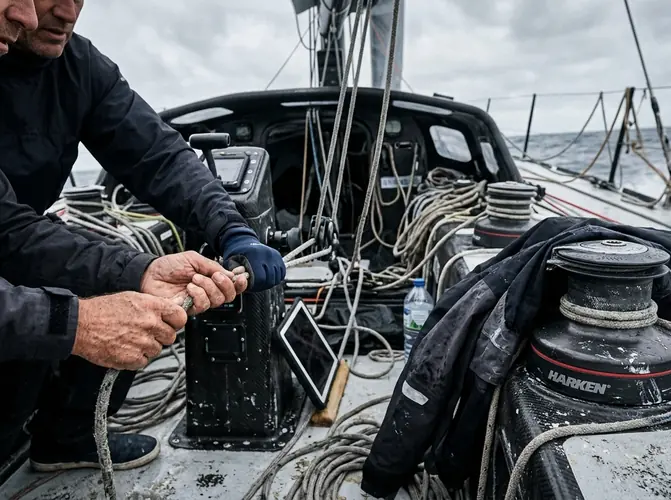
The soundest implementations reveal themselves through behaviour: sustained pace, no publicly reported requirement to lock or depower the keel, and a continuing willingness to carry an assertive sail plan in useful pressure. These signs do not expose proprietary hydraulic logs, but they show whether a skipper appeared able to call on the boat's designed power.
The successful package was integrated. Keel structure, hydraulic circuits, controls, inspection access and deck handling all had to support one another. Treating the keel as a bolted-on upgrade missed the operational point. If a skipper could not inspect, isolate or secure the installation at sea, the design remained incomplete regardless of its dockside sophistication.
Trust in the complete system mattered most on sustained reaches, where usable righting moment allowed the boat to power up rather than retreat into a protective mode.
Why Sail Plans, Routing, and Reputation Ranked Second
A sound canting-keel installation did not guarantee victory. Weather position, sail handling, appendage damage and skipper decisions still separated boats whose ballast systems remained fully available.
The ranking is about dependency. Keel availability came first because it determined how much sail force the hull could convert into forward motion. Routing and sail selection could then refine that capability, but neither could recreate righting moment lost through reduced cant or a keel centered for safety.
- Keel structure and hydraulic availability: A restriction immediately changes allowable heel, sail area and steering load.
- Routing and weather interpretation: Forecast decisions matter only if the yacht can exploit the selected pressure and wind angle.
- Sails, rudders and daggerboard choices: These influence balance and efficiency while the keel remains the principal movable ballast mass.
- Skipper record: Experience improves diagnosis and restraint, but it cannot restore hydraulic pressure or repair a damaged fin root during the same watch.
The leading three monohulls reached Boston within less than five hours of one another. Against that narrow interval, one hardware-imposed period under reduced sail could outweigh several otherwise sound routing calls.
Engineering Maturity Versus Experimental Risk in One Generation
By 2008, canting keels were established technology within the IMOCA class. The unresolved work lay in implementation: ram redundancy, seal durability, pivot alignment, local reinforcement, corrosion control and realistic access for inspection.
Maturity meant repeatable function offshore. A mature package held pressure, controlled bearing clearance and transferred cyclic loads into the hull without progressive movement. It also gave the skipper workable options when something looked wrong.
Serviceability as part of performance
At-sea serviceability did not mean asking one skipper to conduct an implausible structural repair in the North Atlantic. It meant checking fluid levels and attachments, isolating a suspect hydraulic circuit, and centering or securing the keel if continued operation became unsafe.
The distinction between mature and experimental systems often appeared after departure. A package could look advanced alongside the dock yet constrain tactical decisions once repeated wave impacts and load reversals accumulated. The real proof interval extended across approximately 2,800 nautical miles, not a short coastal test.
For historians of the class, this changes the emphasis. The 2008 story was less about who possessed a canting keel than who had finished the engineering around it.
What the 2008 Generation Handed to Later IMOCA Cycles
Later 60-foot monohulls inherited both the power of movable ballast and the obligation to prove the complete load path. The relevant unit included the bulb, fin, pivot, bearings, hydraulic rams, attachment structure, controls and emergency securing arrangements.
That legacy is best used as an inspection question. Before interpreting a result sheet, researchers should establish whether the ballast system remained available at its intended operating level. Damage reports and skipper communications should be checked for any period when the keel was centered, locked, run at reduced cant or monitored because of leakage or structural movement.
The same habit helps followers comparing IMOCA development with Class 40 racing. The class rules and engineering solutions differ, but the analytical principle holds: ballast configuration shapes the power a hull can use, while reliability determines whether that power survives an ocean passage.
Bottom Line: Within the May 2008 fleet, confidence in the complete canting-keel installation offers the clearest single engineering lens for separating boats able to sustain design power from those forced into protective operation.
The Closing Judgment
The first three monohulls completed the crossing within 4 hours, 32 minutes and 55 seconds of one another after passages exceeding twelve days. Such a compact finish rewards examination of temporary restrictions, not just dramatic retirements or retrospective reputations.
If the 2008 fleet had to be ranked by one system alone, would canting-keel maturity remain first, or do the surviving race narratives identify another factor with a stronger direct effect on sustained pace?