In this Article
- Setting the Stage for the 2008 Artemis Transat
- Loïck Peyron Background and Approach
- Execution of the Record-Breaking Passage
- Lasting Influence on Solo Offshore Racing
Setting the Stage for the 2008 Artemis Transat
The Artemis Transat stands as a defining solo offshore challenge, pitting elite IMOCA 60 and Class 40 yachts against the North Atlantic from Plymouth to Boston. The race office framed the 2008 crossing as a singlehanded westbound Atlantic passage. Rather than treating every finisher as one fleet, organizers separated results by measurement class.
The start was set from Plymouth, England, on 11 May 2008. Competitors faced a commonly cited course length of roughly 2,800 nautical miles to the finish line off Boston, Massachusetts. According to participant data, the entry structure used two principal divisions: 13 IMOCA 60-foot monohulls and 11 Class 40 monohulls. Each division raced under its own class expectations and safety controls.
Caveat: elapsed-time comparisons are defensible strictly for the same Plymouth-to-Boston solo course and class framework; later transatlantic editions with different finish ports or fleet rules should be treated as separate records.
Loïck Peyron Background and Approach
Loïck Peyron entered the 2008 start with prior victories on the exact same solo westbound transatlantic line in 1992 and 1996. This historical baseline provided the archive with a 1992-2008 performance arc rather than a single-race résumé. His campaign choice centered on a modern IMOCA 60. The practical decision paired prior solo route knowledge with a highly developed technical platform.
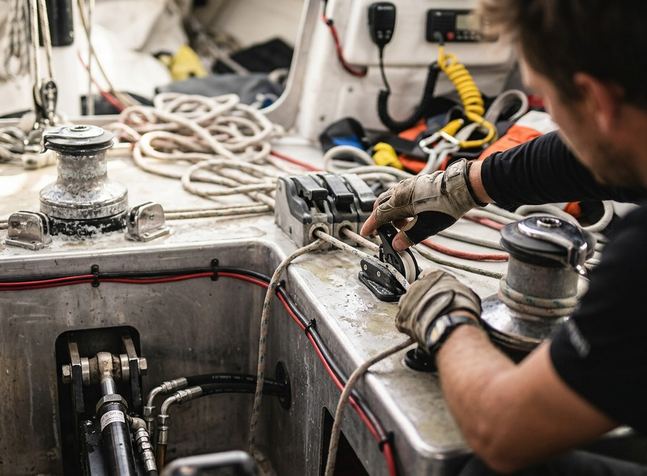
The 2008 vessel featured class-typical offshore systems. These included a canting keel, singlehanded sail controls, safety communications, and heavy autopilot dependence for sleep-managed racing between 11 and 24 May 2008.
Field Note: Class 40 routing and elapsed-time expectations varied significantly from the IMOCA fleet because the boats differed in length, displacement, sail-carrying power, and recovery speed after weather transitions.
Execution of the Record-Breaking Passage
The winning passage required risk-managed routing rather than a straight rhumb-line sprint. The operational weather problem presented the classic May westbound North Atlantic mix—headwind sectors from passing depressions, cold-water fog risk toward the western approaches, and tactical pressure to maintain momentum through lighter transitions before the Boston landfall.
Peyron had to preserve boat speed while avoiding structural damage. He constantly evaluated when to carry sail, when to reef, and when to rely on the autopilot during heavy weather.
He finished first in the IMOCA division on 24 May 2008. The official elapsed time was 12 days, 11 hours, 45 minutes, and 35 seconds from the 11 May start. Using the nominal 2,800-nautical-mile course distance, that elapsed time implies an average near 9 knots.
Important: The roughly 9-knot figure must be read as a course-average benchmark, not a logged-water speed.
Lasting Influence on Solo Offshore Racing
The 2008 finish secured Peyron a third victory on this solo transatlantic line. The result became durable because it linked three distinct layers of evidence: repeated success on the route, an IMOCA-era monohull record pace, and subsequent offshore design priorities.
Community observation suggests the outcome reinforced the value of reliable canting-keel monohulls, solid autopilot integration, and sail plans that a single skipper could manage repeatedly across a 12-day-plus Atlantic passage.
His later crewed around-the-world benchmark, completed in January 2012 with a recorded time of 45 days, 13 hours, 42 minutes, and 53 seconds, demonstrates that the 2008 record sat within a broader career shift. He transitioned from solo 60-foot monohull racing to very large multihull record programs.
Bottom Line: Treating the passage as a generic Atlantic speed record is a failure case; the defensible comparison remains the singlehanded Plymouth-to-Boston monohull course used by the 2008 race office.