
In this Article
- Founding the Observer Single-Handed Trans-Atlantic Race
- Visionaries Behind the Race: Hasler and Chichester
- Decades of Development Until 2004
- Transition to the Artemis Transat in 2008
- Enduring Influence on Offshore Racing
The Artemis Transat did not appear as a clean break from earlier offshore racing. It emerged from a harder, older proposition: one skipper, one monohull, and a westbound North Atlantic passage from Plymouth toward the American coast.
That proposition began as the Observer Single-Handed Trans-Atlantic Race, widely known as OSTAR. By the time the race reached the 2008 Artemis Transat edition, its competitive surface had changed: IMOCA Open 60 entries, Class 40 boats, formal race administration, and a more clearly segmented professional fleet. Yet the central test remained recognisable to anyone who had followed the race from its 1960 departure.
Founding the Observer Single-Handed Trans-Atlantic Race
A private challenge made public
The original OSTAR took shape when Blondie Hasler and Sir Francis Chichester turned a private argument about solo ocean capability into a formal race. Their test was deliberately narrow. A skipper would sail alone. The boat would be a monohull. The passage would run westbound across the North Atlantic from Plymouth.
The inaugural fleet left Plymouth on 11 June 1960 with five starters. That small fleet matters because it fixes the scale of the first event. This was not a mass-participation offshore festival, nor was it yet the class-managed professional contest that later editions would become. It was an experimental crossing with a public start line.
Important: A generic transatlantic race timeline can mislead if it merges the early New York finish pattern with later Boston finishes. The original crossing ran from Plymouth toward the U.S. East Coast, with New York used as the early finish destination.
The value of a simple rule set
The race’s founding strength lay in its simplicity. It did not need a dense technical framework to establish meaning. The first question was whether a solo skipper could manage a westbound ocean race under sustained exposure to weather, fatigue, navigation demands, and mechanical strain.
That simplicity also made the result legible. The first winning passage was completed in 40 days, 12 hours, and 30 minutes. The figure should not be read as a modern performance benchmark. It belongs to a different technological and administrative world. Its real value is historical: it shows how the race began as a measure of endurance before it became a measure of class performance, routing discipline, and sponsor-backed preparation.
From the outset, Plymouth was more than a convenient port. It gave the start a maritime identity tied to Atlantic departure rather than coastal spectacle.
Visionaries Behind the Race: Hasler and Chichester
Two different forms of credibility
Hasler and Chichester brought different assets to the same problem. Hasler supplied the provocation and the practical solo-sailing concept. Chichester supplied ocean-navigation authority and public visibility. The partnership worked because neither role duplicated the other.
Hasler’s own entry, the junk-rigged monohull Jester, gave the race a direct link to experimental seamanship. He did not merely propose a format from shore. He entered a boat that reflected a distinct view of manageable solo sailing: simple systems, rig handling that suited one person, and an acceptance that the skipper’s working capacity set the true boundary.
Chichester’s Gipsy Moth III gave the inaugural race another kind of authority. He sailed the boat and won the first crossing. That result put a recognisable navigational figure at the centre of the event and helped the race reach a wider public than a private challenge could have done.
What their decision-making preserved
The founder-to-start development period culminated in the 11 June 1960 Plymouth departure. In strategic terms, the key decision was not only to race across the Atlantic. It was to preserve the single-handed condition as the event’s organising principle.
Many offshore races test crew management, watch systems, and boat handling under pressure. OSTAR tested a more isolated form of command. The skipper had to act as navigator, helmsman, systems manager, sail handler, and risk officer. That compression of responsibility became the race’s enduring signature.
Field Note: In historical race analysis, Hasler and Chichester are best treated as complementary founders rather than interchangeable pioneers. One sharpened the solo-sailing challenge; the other helped make it publicly credible.
This distinction matters when tracing the line toward the Artemis Transat. The later race inherited more than a course direction. It inherited a theory of offshore competition in which the individual skipper remained the central unit of analysis.
Decades of Development Until 2004
Continuity without stasis
From 1960 through 2004, the race line continued across successive editions, generally following a four-year rhythm. The premise stayed stable: a single-handed westbound transatlantic contest. The environment around that premise changed steadily.
Bigger fleets create different problems from small experimental fields. Faster boats compress decision time. More visible race starts demand clearer controls around harbour traffic, exclusion areas, and public interest. Organisers did not abandon the founding idea; they had to administer it with more precision.
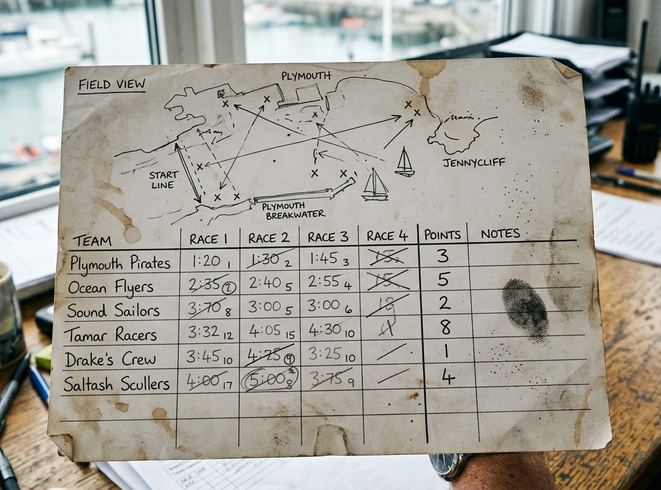
The 2004 edition shows that shift clearly. It used a Plymouth-to-Boston westbound course and started on 31 May 2004. By then, the race could not depend on informal seamanship culture alone. It needed documented procedures that mariners, competitors, race officials, and local traffic could understand before the start.
Safety administration becomes part of race history
Start-area management in 2004 included formal notices for mariners covering navigation restrictions, traffic awareness, and race-related activity in Plymouth waters. That detail can look administrative, but it marks a significant phase in the race’s development.
Solo offshore racing creates risk before a boat reaches open water. A start off Plymouth concentrates racing yachts, support craft, commercial traffic, spectators, and official vessels in a limited area. The Notice to Mariners framework helped define who could be where, what activity was expected, and how ordinary navigation should account for the race.
This was not the romantic side of OSTAR, but it was essential to its survival as a serious event. The race had grown beyond the scale at which shared understanding among a few skippers could carry the operational burden. Formal communication became part of the safety system.
- Single-handed racing still defined the competitive test.
- The westbound North Atlantic route continued to expose skippers to prevailing systems.
- Race management had to account for start-area control and traffic awareness.
- Documentation became a practical tool, not merely a legal formality.
By 2004, OSTAR had become both an athletic challenge and an administrative model. That dual identity set the conditions for the 2008 transition.
Transition to the Artemis Transat in 2008
A successor race with class-based structure
The 2008 edition preserved the solo westbound identity while presenting the race through modern monohull classes. The fleet started from Plymouth on 11 May 2008 and raced toward Boston. The route still asked the old question: how does one skipper manage a racing monohull against the North Atlantic?
The answer now depended heavily on class context. The principal monohull divisions included IMOCA Open 60 boats and Class 40 boats. They belonged in the same broad race story, but not in the same technical frame. A 60-foot IMOCA campaign and a Class 40 campaign carried different performance expectations, preparation models, and sponsor economics.
Important: The 2008 fleet cannot be described as one uniform technical group because IMOCA Open 60 boats and Class 40 boats followed different class expectations and performance ranges.
Reading the Class 40 presence
Simon Clarke was recorded among the Class 40 competitors in the 2008 edition. That single example is useful because it keeps the discussion concrete. The Class 40 division helped widen the competitive architecture without dissolving the race’s monohull identity.
For sponsors and teams, Class 40 offered a different proposition from IMOCA. It did not need to imitate the 60-foot fleet to be meaningful. It gave the Artemis Transat another way to express solo transatlantic discipline: smaller monohulls, class-specific comparison, and a performance range suited to a distinct campaign scale.
Arrivals ran from late May into early June 2008. That spread reflected class speed differences and North Atlantic weather exposure rather than a simple ranking of courage or competence. In offshore analysis, this distinction matters. A finish list tells part of the story; the class framework explains how to read it.
The Artemis Transat name therefore marked a transition in presentation, sponsorship, and fleet language. It did not erase the older race logic. It translated it into a professional structure that could accommodate IMOCA Open 60 and Class 40 competition without pretending they were the same contest.
Enduring Influence on Offshore Racing
Standards formed through repetition
The race’s influence came less from a single edition than from repeated exposure to the same hard operating conditions. Solo watchkeeping limits, heavy-weather routing, emergency communications, collision risk near busy approaches, and documented start controls all became part of the offshore racing conversation.
The archive span from 1960 through 2008 shows a shift from small experimental solo entries to class-based professional fleets. That shift did not remove the founding pressure. It made the pressure more visible, more regulated, and more legible to teams, race offices, sponsors, and maritime authorities.
The westbound route from Plymouth to the U.S. East Coast placed competitors against prevailing North Atlantic systems during the May-to-June race window. That seasonal and directional pattern gave the race its particular severity. It was not simply long-distance sailing; it was a specific confrontation with weather, fatigue, and routing choices on an unfriendly axis.
Why the legacy still matters
Safety administration by 2004-2008 included formal competitor documents, class eligibility checks, start-area controls, and published marine notices. These measures did not make solo racing tame. They made its risks more accountable.
That is the lasting contribution of the OSTAR-to-Artemis Transat line. It showed that high-risk solo ocean racing could keep its central character while adopting clearer standards. The race remained a test of the individual skipper, but it no longer relied on individual nerve as its only organising principle.
Bottom Line: The Artemis Transat 2008 should be read as the modern expression of an older OSTAR design: single-handed, westbound, monohull racing from Plymouth toward the American coast, reshaped by class structure and formal race administration.
The legacy is strongest for single-handed westbound monohull racing; it should not be stretched to explain crewed multihull records or eastbound delivery passages. Within its proper field, though, the influence is substantial. OSTAR established the proposition. The Artemis Transat carried it into a fleet environment shaped by IMOCA Open 60 campaigns, Class 40 entries, sponsor visibility, and documented maritime controls.
For race historians, that continuity is the central point. Names changed. Finish ports evolved. Administration became more formal. The North Atlantic test remained recognisable.