In this Article
- The Round-the-World Bias in a North Atlantic Sprint
- Tracing Shared-Labour Assumptions in Hull and Deck Layouts
- The 300-Hour Solo Workload from Plymouth to Boston
- Friction Points Between Complex Inventories and Single-Handed Fatigue
- Reimagining the 18.28-Metre Platform for a Single Operator
- Interpreting Conservative Routing as Rational Platform Management
- Mapping the Fleet Configuration Data
The Round-the-World Bias in a North Atlantic Sprint
The westbound solo race that started from Plymouth on 11 May 2008 and finished off Boston served as a brutal testing ground for the era's premier offshore monohulls. The course ran approximately 2,800 nautical miles against the prevailing west-to-east weather movement of the North Atlantic. Designers and syndicates approached this event during the critical 2007-2008 development cycle, a period heavily focused on the late-2008 solo circumnavigation for which many campaigns were actively preparing. The 2008 IMOCA generation carried the design assumptions of those multi-month, multi-mode campaigns directly into a short, violent solo sprint.
The first IMOCA completed the passage in 12 days, 11 hours, 15 minutes and 35 seconds. This winning elapsed time of more than 299 hours placed the decisive workload inside a 12- to 16-day operating window. A multi-month circumnavigation allows a skipper to establish a sustainable rhythm of maintenance, sleep, and strategic pacing. The Artemis Transat demanded continuous, high-intensity output without the possibility of long-term recovery. The boats entered this specific arena optimized for a completely different endurance profile.
Evaluating the fleet requires separating the inherent capability of the yachts from their suitability for this exact route. The 13 IMOCA starters represented the pinnacle of offshore engineering at the time. Their platforms generated massive power and righting moment. Applying that power effectively as a solo operator in a two-week sprint against prevailing headwinds exposed the gap between a boat built for the Southern Ocean and a boat built for the North Atlantic.
Tracing Shared-Labour Assumptions in Hull and Deck Layouts
The class box limited hull length to 18.28 metres. Within that strict parameter, designers sought performance advantages through canting keels, daggerboards, asymmetric appendage arrangements, and water ballast. These systems required substantial physical effort and mechanical advantage to operate. During the 2007-2008 campaign cycle, the same generation of boats moved fluidly among solo, double-handed, and occasional crewed configurations. Syndicates used removable bunks, altered sail inventories, and reassigned deck roles to change the operating model without changing the underlying hull.
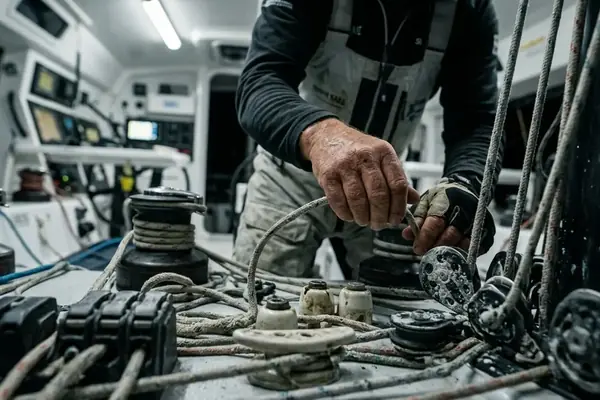
This shared-labour DNA embedded itself deeply into the deck layouts and power budgets of the fleet. Winch positions, pedestal locations, and cockpit ergonomics reflected an assumption that multiple people could share the physical burden of maneuvering. A crewed configuration allows one sailor to grind while another tails a line, a third manages the helm, and a fourth coordinates the foredeck. The deck hardware geometry on many 2008 entries facilitated this choreographed multi-person workflow.
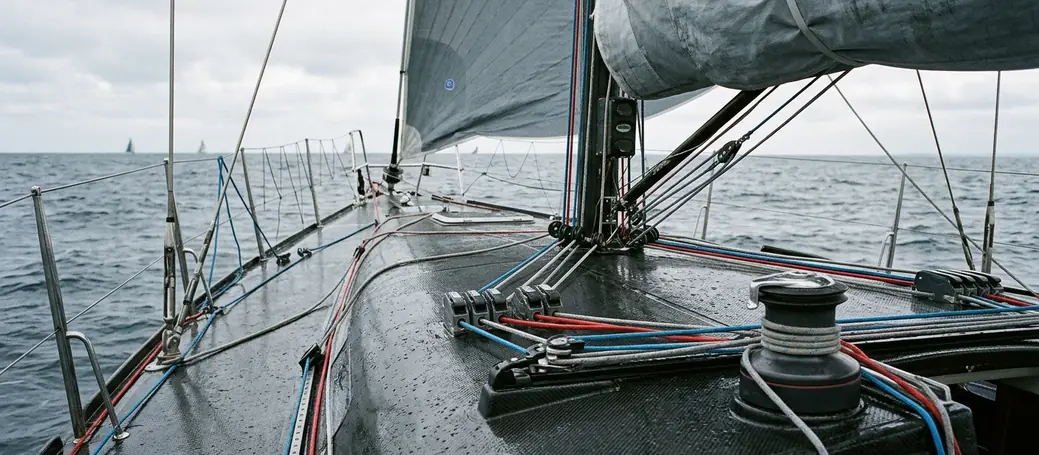
Power budgets similarly reflected crewed priorities. Generating the electricity required to run canting-keel hydraulics, navigation computers, and satellite communications often involved running the engine. In a crewed scenario, monitoring the charging cycle and managing the electrical load is a delegated task. For a solo skipper, initiating a charging sequence adds another mandatory item to an already saturated task list. The physical architecture of the boats assumed a division of labour that simply did not exist between Plymouth and Boston.
The 300-Hour Solo Workload from Plymouth to Boston
A westbound passage from 11 May into late May exposed the fleet to successive North Atlantic depressions. The route guaranteed cold water, steep head seas, changing ice information, and repeated transitions between reaching and upwind configurations. The environment offered no stable trade-wind sailing where a skipper could lock in a configuration and rest. Every weather front required a proactive response to manage the rising wind and shifting sea state.
One skipper had to manage the helm or autopilot, navigation, weather downloads, sail trim, reefing, food, communications, and repairs continuously. The decision load remained unbroken. A single routing decision could trigger a cascade of physical tasks: a reef, a headsail change, a ballast adjustment, a stack transfer, and an autopilot reset. While the Class 40 entries faced their own severe endurance tests in the same weather systems, the sheer physical scale of the 18.28-metre IMOCA platform amplified the energy required for every maneuver.
Sleep fragmentation became a defining characteristic of the race. The 12- to 16-day operating window forced skippers to take rest in micro-bursts, often sleeping in foul weather gear on the cabin sole near the companionway. The constant need to monitor radar for ice, download the latest GRIB files, and adjust to the shifting wind direction prevented any deep recovery. The boats demanded a level of continuous physical intervention that pushed human physiology to its absolute limit over the 300-hour duration.
Friction Points Between Complex Inventories and Single-Handed Fatigue
The collision between design priorities and solo sprint reality became most apparent during sail changes. A larger sail inventory increased configuration choice, theoretically allowing the boat to match the exact wind speed and angle. Every additional change meant leaving navigation tasks, preparing halyards on an exposed foredeck, and wrestling heavy canvas in building seas. The physical cost of the change often outweighed the theoretical performance gain.
Sail stacking represented a massive drain on the skipper's energy reserves. A tack involved shifting several bagged sails across the interior or deck so that movable weight remained on the windward side. Moving hundreds of kilograms of wet sails across a pitching deck or through a cramped cabin required immense physical exertion. The operation then had to be repeated after the next major course change. In a multi-month race, tacks are infrequent. In the North Atlantic depressions, the frequency of maneuvers turned sail stacking into a continuous, exhausting cycle.
Systems interdependence further complicated the solo reality. Canting-keel hydraulics, autopilot drives, navigation computers, satellite communications, pumps, and charging equipment formed an interdependent electrical and hydraulic chain throughout the sprint. A fault in one part could consume the rest period intended before the next front. Diagnosing a hydraulic leak or a charging failure required the skipper to abandon the helm and focus entirely on the repair, relying completely on the autopilot in heavy seas. This comparison concerns the IMOCA boats strictly as configured for the May 2008 crossing; projecting these friction points onto later generations with enclosed cockpits, foils, and revised sail limits obscures the specific mechanical realities of that cycle.
Reimagining the 18.28-Metre Platform for a Single Operator
Designing a platform specifically for a 12- to 16-day solo North Atlantic sprint requires starting with the skipper's highest-frequency actions and building outward. A solo-first cockpit routes reefing controls, traveller or mainsheet controls, furling lines, and autopilot interfaces so that a reef can be initiated without repeated trips between the helm zone, mast, and companionway. Centralizing these controls minimizes the time spent exposed on deck and reduces the physical steps required to depower the boat.
The electrical design for a short sprint prioritizes continuous pilot and instrument operation, accessible charging controls, and the immediate isolation of failed circuits. The system cannot assume that a second sailor is available to steer manually while the primary operator diagnoses a fault below deck. Redundancy must be built into the switching and routing, allowing the solo skipper to bypass a failed component instantly and maintain the boat's heading.
Evaluating Sail Inventory Utility
A complex sail inventory remains useful during a short crossing provided furling, halyard routing, and stack movement allow one skipper to change configuration safely. The extra options serve the solo sailor only when the physical cost of deployment falls below the performance gain. If a headsail change requires dragging a bagged sail from the stern to the bow in the ballpark of 30 knots of wind, the skipper will likely choose to sail under-optimized rather than risk exhaustion or injury.
Maintenance access and failure modes also require a solo-first approach. Pumps, hydraulic rams, and charging alternators must be positioned where a single person can reach them in foul weather gear while the boat is heeled at an angle hovering around 25 degrees. The 2008 fleet often buried critical systems behind bulkheads or under stacked sails, reflecting a design assumption that the boat could be stabilized by a crew while repairs were conducted.
Interpreting Conservative Routing as Rational Platform Management
Reading the 2008 skipper choices through the lens of this boat-brief mismatch changes the interpretation of the race data. A delayed sail change or a conservative routing decision indicates a rational attempt to avoid an exposed foredeck operation before a front arrives. Skippers actively managed their own fatigue levels, trading theoretical boat speed for physical preservation. The platform dictated the strategy.
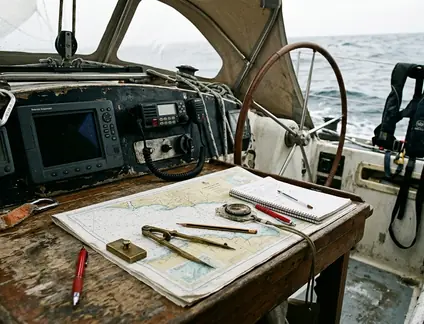
Archive evidence reveals the extent of the equipment workarounds required during the crossing. Race reports from the period document pilot resets, charging problems, hydraulic leaks, halyard damage, torn sails, and ballast faults. Each of these incidents forced the skipper to improvise solutions using systems designed for multiple operators. The frequency of repeated trips forward during the roughly two-week passage highlights the ergonomic friction of the deck layouts.
Photographs from 11 May through the late-May finishes provide crucial documentation of these challenges. Tracing the physical distance between the companionway, primary winches, reefing controls, pilot display, keel controls, and mast reveals the actual workflow demanded by each boat. Cockpit suitability varies heavily by configuration as well as hull generation. Two nominally similar 2008 boats could have entirely different winch positions, pilot interfaces, reefing arrangements, and charging systems, leading to vastly different solo experiences.
Mapping the Fleet Configuration Data
Begin with the 13 IMOCA starters listed for the May 2008 race and keep their records separate from the smaller Class 40 designs. Open the fleet pages and compare sail inventories, cockpit layouts, and autopilot notes boat-by-boat. Cross-reference the pre-start fleet material from April and May 2008 with the finish reports from late May, and then track those same hulls into their later campaign records from November 2008 through January 2009. Map the configuration changes between those specific windows to determine exactly which features were race-specific adaptations and which were permanent platform liabilities.